The Architecture of Trust
- Mar 23
- 3 min read
Notes from the Monaco Women Forum 2026 by Anastasiia Lutcenko

Friday is rarely an easy day, and yesterday promised little exception — until it quietly turned into something rather more engaging: the MONACO WOMEN FORUM 2026.
From its very opening moments, the tone felt less ceremonial than expected, and far more thought-provoking than most conferences dare to be.
It was in this setting that Pierre-André Chiappori delivered a speech marked by clarity, nuance, and a rare intellectual honesty when addressing systems in transition.
One line, in particular, deserves attention:
“The code makes you the owner.”
It is not often that a finance minister articulates, with such precision, a shift that challenges one of the foundational assumptions of modern economic systems — that ownership must be defined and safeguarded through institutional frameworks.
For years, we have been told that finance is evolving. The phrase has become so familiar that it risks losing its meaning. And yet here, the suggestion felt grounded.
If ownership can indeed be encoded, if trust can be embedded directly into technological systems, then the role of intermediaries is not dismissed — but quietly reconsidered.
What made the intervention all the more striking was its restraint.
There was no suggestion that Monaco intends to move abruptly into this new architecture. On the contrary, the approach outlined was one of careful alignment and continuity — with European frameworks such as MiCA, with sustained attention to anti-money laundering standards, and above all, with a long-standing commitment to credibility and institutional trust.
In an environment often driven by speed and disruption, this position appears less conservative than it does deliberate.
And yet, a question emerged:
“Can you prove that it actually works?”
Not whether systems can be designed, nor whether frameworks can be adopted — but whether they can demonstrate effectiveness in practice.
A shift in emphasis that extends beyond digital assets, into the very question of legitimacy.
It was here that another remark acquired its full significance:
“Justice goes at its own pace.”
A reminder that even in an era shaped by technological acceleration, certain institutional principles cannot be subjected to the same logic.
What the speech ultimately revealed was not a conclusion, but a negotiation: between innovation and responsibility, between transparency and control, between a system that is evolving and one that remains — quite understandably — unwilling to relinquish its foundations too quickly.
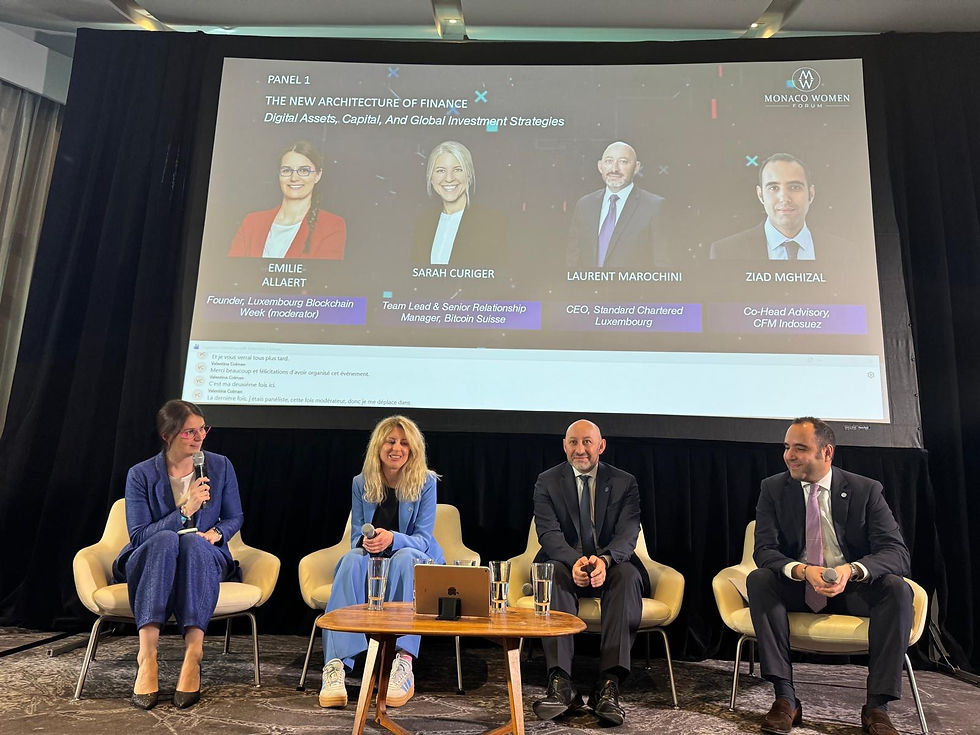
If the Minister’s speech outlined the architecture, the first panel revealed how it is already being inhabited.
There was no urgency, no theatrical declarations of disruption — only a quiet recognition that the shift so often discussed in theory has, in fact, begun.
The discussion remained clair thanks to the moderation of Emily Allaert, a founder of Digital Minds and Luxembourg Blockchain Lab. The familiar question — whether digital assets will reshape finance — was gently set aside.
The real question now appears to be: not whether, but how.
“We have no choice but to adapt — otherwise clients will go elsewhere.”
As Sarah Curiger of Bitcoin Suisse observed, the shift now seems difficult to reverse.
“The question is no longer should we invest — but how do we access the space.”
What once required conviction now appears as a response to demand — not initiated by institutions, but emerging from their clients.
From within global banking, Laurent Marochini of Standard Chartered offered a perspective both pragmatic and quietly ambitious:
“Blockchain will be the infrastructure of tomorrow.”
And yet, what he described was not disruption, but coexistence — a gradual reconfiguration of systems that continue, for now, to operate side by side.
Perhaps the most measured reflection came from Ziad Mghizal of CFM Indosuez Wealth Management:
“Demand is clearly there — but banks are moving more cautiously.”
A reminder that in certain financial cultures, change is not resisted — it is absorbed, tested, and only then allowed to unfold.
One theme, however, united all perspectives: education.
“If you step away for six months — it’s already over.”
And yet, at one point, the conversation shifted — almost imperceptibly — from infrastructure to something more fundamental. A question from the audience:
If data is becoming a new form of currency, who ultimately should control it?
Decentralisation.
Individual responsibility.
A redistribution of control — in theory.
And yet, no definitive answer emerged.
Perhaps that was the most revealing moment of all. Because behind the discussion of assets, regulation, and infrastructure lies a deeper question — not how we trade, but who holds power.
For centuries, finance has been built on delegated trust — institutions designed to verify, protect, and legitimise.
Now, for the first time, that trust begins to migrate. From institutions — into systems. From authority — into code. And if that movement continues, even gradually, even cautiously, it may not simply transform finance. It may redefine the very idea of who — or what — we choose to trust.