


Jean-Christophe Maillot and Bruno Mantovani at the Monaco Press Club
- Apr 2
- 4 min read
At the Monaco Press Club, a conversation on Printemps des Arts became a meditation on music, presence and art in the age of AI.
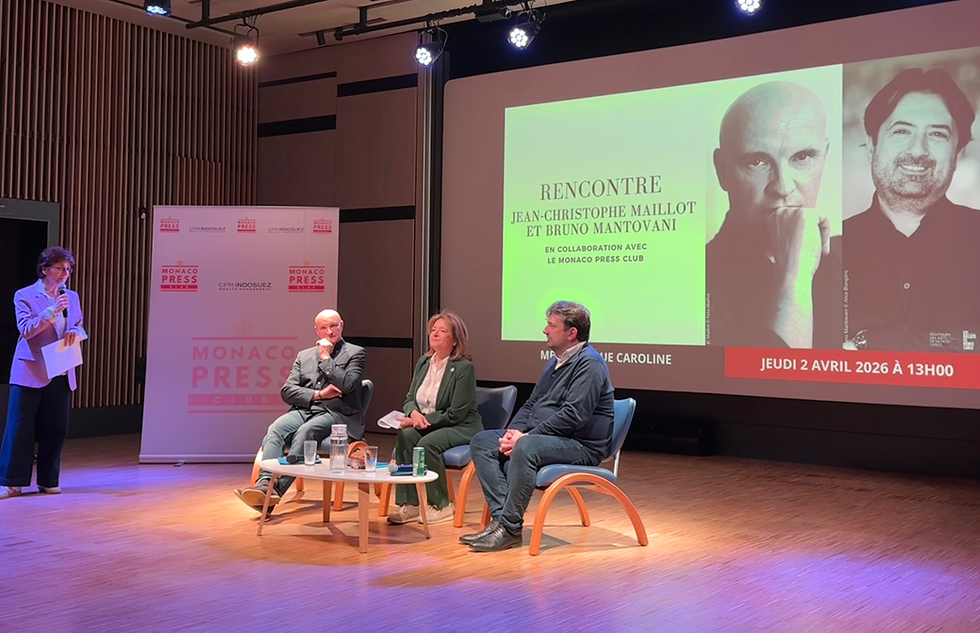
On 2 April, the Monaco Press Club hosted an exceptional encounter: a public conversation between Jean-Christophe Maillot and Bruno Mantovani around their collaboration on Miniatures, which will be presented from 16 to 19 April at the Grimaldi Forum. The club framed the event as an opportunity to understand the close dialogue between music and dance — its artistic stakes, inspirations and creative process. That promise was fully kept. More than that, the Monaco Press Club deserves praise for continuing to create room for discussions of this kind: serious, articulate and genuinely illuminating.
Moderated by Cinzia Colman, president of the Monaco Press Club, this meeting began as a conversation about ballet, music and audiences, and ended as a reflection on artistic freedom, public taste and the uncertain future of human presence in an age increasingly drawn to simulation.
What made the evening unusual was the absence of the usual cultural boilerplate. There was little managerial optimism, little worship of accessibility for its own sake, and no real interest in the now familiar language of “relevance.” Instead, both Maillot and Mantovani defended something that sounds almost unfashionable: the right of art not to flatter.
Maillot was the more fluid philosophical presence. He resisted fixed categories and spoke instead of artistic territories that may appear contradictory but are, in fact, complementary. Yet on one point he was entirely clear: the body remains central, and music remains sovereign:
“I deeply love the human body, and the moment it moves, something in it inevitably speaks to me.”
And if the body is his medium, music is his law:
“Music, I would dare say, as a choreographer, remains for me the supreme art.”
Choreography, for him, is not an idea imposed on movement; it is born from music. That sounds obvious until one remembers how rarely it is now said with conviction.
Mantovani sharpened the point. He spoke about how rare it is to encounter a choreographer who truly hears music rather than merely using it. Of Maillot, he remarked with telling admiration that he
“spoke about music in a way that is extraordinary for a choreographer” since “most choreographers are deaf to music — intellectually deaf, musically deficient.”
The discussion became sharper when the subject turned to the audience. Has the public changed? Has attention worsened? Must art simplify itself in order to survive? Maillot’s answer was :
“The audience accepts what it is offered.”
The real failure, in his view, lies in programming that mistakes simplification for generosity. His most memorable line of the evening also happened to be its most elegant: one must
“give pleasure without trying to please.”
Mantovani, unsurprisingly, went further. He admitted, almost mischievously, that
“I programme the Printemps des Arts first and foremost for myself.”
Creation, he argues, does not begin in demagogy but in necessity; indeed,
“to share that selfishness — that is the supreme joy.”
Then came the digital question. Neither Maillot nor Mantovani sounded remotely nostalgic. Maillot spoke about the Ballets de Monte-Carlo’s digital platform, insisting that technology should not offer a weak substitute for live performance but a genuinely different perspective on it — backstage views, rehearsals, another angle, another proximity. Yet both men were plainly wary of what digital culture rewards. Mantovani noted that musicians’ CVs now sometimes begin with follower counts —
“followed by X number of Instagram followers — at which point I usually stop reading.”
It was a comic line, but not a trivial one. It pointed to a broader shift in cultural value: from craft to visibility, from formation to exposure.
Maillot’s concern was even sharper. He warned that
“the standardisation of choreography is already underway,”
as young artists absorb one another so constantly that singularity begins to thin out into resemblance. Then came perhaps the most cutting formulation of the evening:
“One hardly needs artificial intelligence to produce a kind of polished mediocrity.”
In other words, one does not need AI to create work that is technically accomplished and spiritually interchangeable. The culture is already doing quite well on its own.
It was precisely there that my own question on AI entered the conversation. I asked whether artificial intelligence might become a new artistic language — one capable of transforming ballet as radically as earlier revolutions transformed music and stagecraft. Maillot’s answer was immediate and grave. AI, he said, represents
“an enormous — truly enormous — change,”
one whose consequences we have not yet begun to measure properly.
What concerned him was not merely the machine, but the fate of the living body. For years, he said, he had joked that he would never see one of his ballets performed exactly as he imagined it. Yet this, far from being a defect, is part of the truth of live art. One returns to the theatre not to witness perfection, but to encounter what living performers bring each time: a new intensity, a new fragility, a new truth. It is precisely because a body is mortal, limited and unrepeatable that it retains its authority on stage.
Maillot evoked the image of breakdancing robots in China and pushed the thought to its unsettling conclusion: cover them in silicone, place them before an audience, and how long before the eye no longer knows what it owes to flesh? The issue, he suggested, is no longer simply AI; it is the arrival of the augmented body. Once that body enters the artistic field in earnest, the old confidence that stage presence belongs to human beings alone begins to weaken.
That, in the end, was the real subject of the evening. Not whether technology can assist art — of course it can — but whether we are in danger of surrendering the very things that once gave art its authority: imperfection, risk, unpredictability, and the unrepeatable force of human presence. The coming struggle will not be between tradition and innovation, nor even between analogue and digital. It will be between presence and simulation, singularity and replication, the living gesture and its increasingly persuasive double.
Do we still know how to value what is fragile, mortal and irreducibly human. Maillot’s answer became a warning:
"Artificial intelligence is an enormous — truly enormous — change."
