


What the Pope’s Visit Revealed About Monaco
- Mar 28
- 4 min read
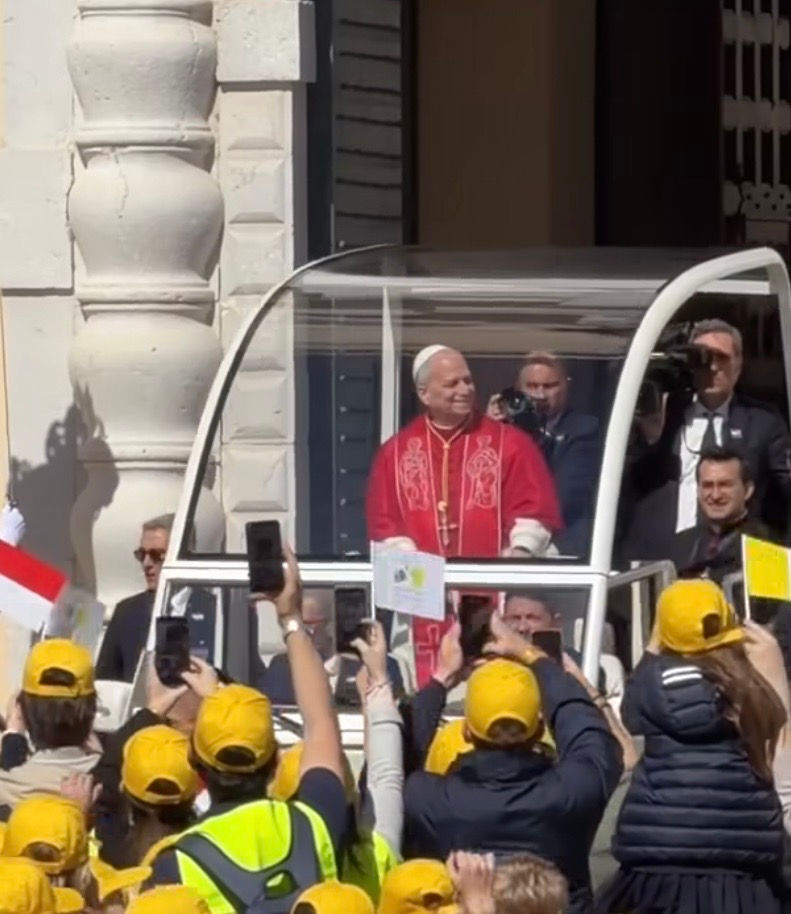
Why should Monaco, of all places, become the setting for a conversation about conscience, fear and responsibility?
At first glance, the answer is not obvious. The Principality is usually seen as a byword for wealth, order and efficiency. Yet that is precisely what made the Pope’s visit so striking. Some arguments acquire greater force in places where systems work, appearances hold, and the question is no longer whether order exists, but what it is ultimately for.
There is something subtler in the Principality, and more difficult to define: a distinctive culture of responsibility, an almost architectural sense of proportion, and a rare ability to combine compactness with influence, tradition with modern efficiency. That is precisely why the Pope’s words, spoken here, did not sound accidental.
Addressing Monaco, he called it
“a great laboratory of solidarity” and “a window of hope.”
One could have taken those words for an elegant diplomatic gesture, had they not carried a more serious tone beneath them. The Pope did not merely praise the Principality. He offered a way of seeing it — as a place where one can observe with particular clarity what a society does with its privilege, its resources and its influence.
This, perhaps, is the particular dignity of small states: their scale does not diminish responsibility, but rather makes it more visible. In large systems, decisions often dissolve into layers of governance, the anonymity of institutions, and the logic of mechanisms too complex to be fully grasped.
A few days before the visit, HSH Prince Albert II said something important in an interview with La Croix :
Catholicism, he noted, is one of the elements that makes Monaco unique, and from this follow strong political choices — both in domestic policy and in international cooperation.
In those words one hears an acknowledgement that faith in Monaco is not merely a matter of inheritance, but a form of responsibility. It cannot remain decorative. It enters the fabric of decision-making. It shapes not only the language of public life, but also the limits of what is considered acceptable.
And it is here that the central question emerges: what follows from what we, as a society, claim to believe?
This is no longer a question of ceremony or symbolism. It is a question of political and moral consistency. If the Catholic tradition truly forms part of Monaco’s singularity, then we are speaking not only of cultural memory, but of a practical logic: how the dignity of human life is understood, how duty toward the vulnerable is conceived, and how prosperity is related to obligation, influence to service.
This question concerns not only Monaco, and not only religion. Yet it sounded here with particular clarity, because in Monaco one sees especially well that sustainability is not only a matter of institutions, but of the inner structure of a society. And perhaps it is precisely here that one may recall a simple yet uncomfortable truth: we too often present sustainable development as a goal that can one day be reached, when in fact sustainability is not a goal at all, but a human capacity — the capacity not to shift long-term responsibility onto systems, regulators or future generations.
That, perhaps, is one of the defining mistakes of modernity. We try to change the world through pressure — political, administrative, moral — and are surprised each time by resistance. But human nature works differently: the greater the pressure, the more tightly a person clings to the old order. This is also a matter of psychology. True change therefore begins not with external coercion, but with inner consent, with discipline, with a person’s willingness to bear within themselves the measure of truth they demand from the world.
Against this background, the Gospel episode to which the Pope referred ceases to be merely religious. After the raising of Lazarus, he reminded his listeners, the decision is taken to eliminate Christ. And the Pope invited us to see in that decision not an outburst of blind rage, but a political calculation born of fear. The force of this idea lies in the way it destroys one of our most convenient illusions: that evil is always irrational. Very often, on the contrary, it presents itself as prudence, as the defence of order, as cold necessity.
Hence his grave, almost merciless question:
How many calculations are made in the world in order to kill the innocent? How many false reasons are invoked to eliminate them?
This is no longer theology in the narrow sense. It is an anatomy of modern violence, which rarely arrives under its own name. It comes in the language of security, of interest, of management, of efficiency. It prefers to speak in the vocabulary of necessity.
And that is precisely why this day in Monaco mattered. Because here, amid order, discipline, beauty and evident prosperity, there came a reminder that the true sustainability of a society is measured not only by the quality of its institutions, but also by the quality of its moral imagination. Not by how effectively it preserves itself, but by what, exactly, it considers worthy of being preserved.
To me, that was the real depth of the visit. It did not disturb Monaco’s harmony. On the contrary, it treated Monaco with respect — as a place whose visibility in the world obliges it to be more than merely successful.
On that day, Monaco became a mirror in which there appeared a question addressed not only to states, but to each individual: what are we truly prepared to defend when we speak of order, and what are we prepared to sacrifice when fear begins to govern us?


