


UN-Habitat and Alwaleed Philanthropies Launch Partnership for Inclusive Housing in Tunisia during WUF13 in Baku
- May 19
- 5 min read
UN-Habitat and Alwaleed Philanthropies formally launched a new partnership during the World Urban Forum (WUF13) in Baku aimed at advancing inclusive and sustainable housing solutions for persons with disabilities in Tunisia and across the Arab region. The initiative combines accessible housing design, inclusive urban planning, renewable energy integration and policy reform in what participants described as a model for future urban development.
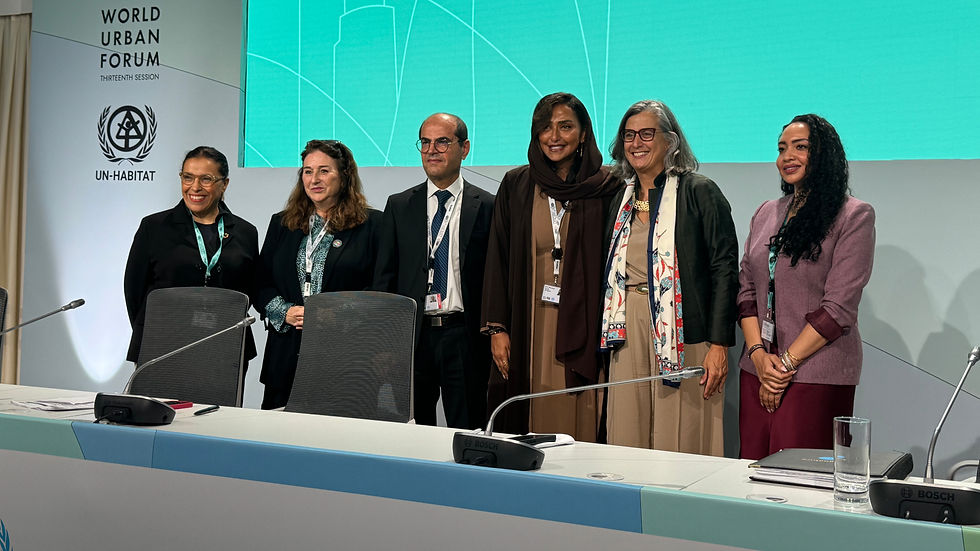
The partnership will support a pilot project in Tunisia focused on “improving access to adequate housing through inclusive urban planning, accessible housing design and tailored housing solutions,” while also promoting “capacity building and policy support to strengthen inclusive housing approaches across the region.”
The high-level side event, held at Baku Olympic Stadium, brought together senior officials, urban practitioners, disability advocates and development organizations to discuss housing accessibility and mental well-being in sustainable cities. Speakers included UN-Habitat Executive Director Anacláudia Rossbach, Princess Lamia Bint Majid Al Saud of Alwaleed Philanthropies, Tunisian Minister of Equipment and Housing Salah Zouari, Reem Mallawi of Alwaleed Philanthropies, UN-Habitat Regional Director Rania Hedeya and Aida Robbana, Head of UN-Habitat Tunisia.
Housing Beyond Shelter
Throughout the discussion, speakers repeatedly stressed that housing must be treated as a human right and not merely as physical infrastructure.
Representing Alwaleed Philanthropies, Reem Mallawi explained that the organization views housing as “more than just a shelter or a place.”
“It tackles dignity, of course, stability, and then opportunity,” she said. “If an individual or a human being is stable and safe, then you will leave the house to go and seek for education, seek for employment, seek for economic independence.”
Mallawi highlighted the long-term economic benefits of inclusive housing projects, citing a partnership with UNHCR in Yemen that restored 650 low-income housing units while generating more than 1,600 jobs and over 35,000 working hours for local communities.
Rania Hedeya, Regional Director of UN-Habitat for the Arab States, framed the discussion around human dignity, rights and long-term sustainability. Throughout the conversation, she repeatedly emphasized that access to safe housing is not a charitable issue but a basic human right.
“We speak about the rights of those citizens to live in dignity, to live in a safe place,” Hedeya said, praising the rights-based approach championed by Alwaleed Philanthropies and Princess Lamia.
She also highlighted the role of culture and storytelling in advancing social change.
“The messages sometimes that we deliver through art are much stronger than the messages that we deliver through our development programmes and projects.”
One of Hedeya’s strongest themes was sustainability and the importance of ensuring communities can continue projects independently after donor funding ends.
“How can we ensure that the local community can sustain and fly solo and ensure that this impact or change is for generations to come?” she asked.
She repeatedly stressed the importance of co-creation with beneficiaries and local authorities, arguing that development projects succeed only when communities themselves shape the process.
In her concluding remarks, Hedeya delivered perhaps the strongest message of the session, insisting that accessibility and inclusion are central pillars of sustainable cities.
“Accessibility and inclusion are not optional components of urban development. They are the heart of sustainable, resilient and just cities.”
Sustainability Beyond Initial Funding
One of the key questions raised during the discussion focused on the long-term sustainability of philanthropic partnerships and what mechanisms are in place to ensure projects continue after funding ends.
Responding to the question, Mallawi stressed that sustainability depends on strong collaboration between international organizations, local authorities and communities themselves.
“We want to ensure that when this philanthropic entity or NGO leaves, that the project is in place and with hands, of course, tailored to the needs of the community,” she said. “And once the funding ends, as you mentioned, and the international nonprofit ends the contract, we know that it's in good hands and it's sustainable, and inshallah, it's for generations to come.”
To demonstrate how long-term impact can continue after a project formally ends, Aida Robbana referenced a previous partnership with Alwaleed Philanthropies focused on waste collectors in Tunisia.
The initiative worked with highly vulnerable waste collectors in Beni Khaled and Sousse, helping formalize their work and improve their livelihoods.
Robbana said that after the project ended, municipalities continued engaging directly with waste collectors.
“Some of them are sitting with them and discussing every day,” she said, describing how workers who had previously been excluded from institutions were now participating in municipal discussions and advocating for their own needs.
The project also supported women working in the circular economy around citrus waste. 43 women received support to develop entrepreneurship initiatives, and some have already launched their own businesses.
“Impact, you can see it after 5 to 10 years,” Robbana said, explaining that UN-Habitat continues visiting communities and municipalities long after formal projects conclude.
Mallawi added that one of the project’s most significant outcomes was changing how society viewed waste collectors.
Before the intervention, many collectors had little recognition or representation. Afterward, they gained formal seats in municipal meetings held every quarter, allowing them to directly voice their concerns and priorities.
“Now they are at the table discussing firsthand what they want and what's their needs and what's their daily challenges,” Mallawi said.
The project also formalized aspects of waste collection through health services, vaccinations and identification cards, helping improve public perception of the workers.
“The perspective changed from the people who are living in the neighbourhood,” she explained.
Leadership, Vision and a Personal Exchange With Princess Lamia
One of the defining elements of the event was the presence and engagement of Her Royal Highness Princess Lamia Bint Majed Al Saud, Secretary General of Alwaleed Philanthropies and UN-Habitat Goodwill Ambassador for the Arab States. Throughout the session, speakers repeatedly acknowledged her role in advancing a more human-centered and rights-based approach to philanthropy and urban development.
Rania Hedeya noted that Princess Lamia’s presence alone sends a strong message of support for inclusive housing and accessibility initiatives.
“Just your presence gives support to the project and to the conversation,” Hedeya said during the closing remarks.
Throughout the discussion, Princess Lamia was repeatedly referenced as a driving force behind projects that prioritize community ownership, policy change and the direct inclusion of beneficiaries in decision-making processes. Participants highlighted her commitment to ensuring that philanthropy does not end with funding cycles, but instead leaves behind systems and partnerships capable of continuing for generations.
Personally, one of the most memorable aspects of the event for me was the opportunity to briefly speak with Princess Lamia following the session. Despite her global profile and demanding schedule, she was remarkably warm, attentive and genuinely engaged in conversations about inclusion and sustainable development.
What stood out most was her ability to combine high-level strategic vision with sincere empathy toward the communities these projects aim to serve. Her approach reflected many of the themes repeatedly emphasized throughout the discussion: listening first, co-creating solutions with communities and ensuring that dignity remains at the center of development work.
In many ways, the conversation in Baku reflected a broader shift in how urban development and philanthropy are being approached in the region — not simply through infrastructure investments, but through partnerships that seek to reshape systems, empower communities and build cities that are truly accessible for everyone.
Building Cities for Everyone
Closing the session, speakers stressed that accessibility and inclusion are fundamental pillars of sustainable urban development.
Participants agreed that the Tunisia initiative demonstrates how partnerships between governments, international organizations and communities can create inclusive housing systems designed not only to deliver short-term support, but also long-term structural change.


