


Behind the Broadcast: A Conversation with BFM’s Marie Chantrait at the Monaco Press Club
- 7 days ago
- 3 min read
At the Monaco Press Club, an audience gathered for a conversation with one of the more formidable figures in French broadcast journalism: Marie Chantrait, head of the political desk at BFM TV.
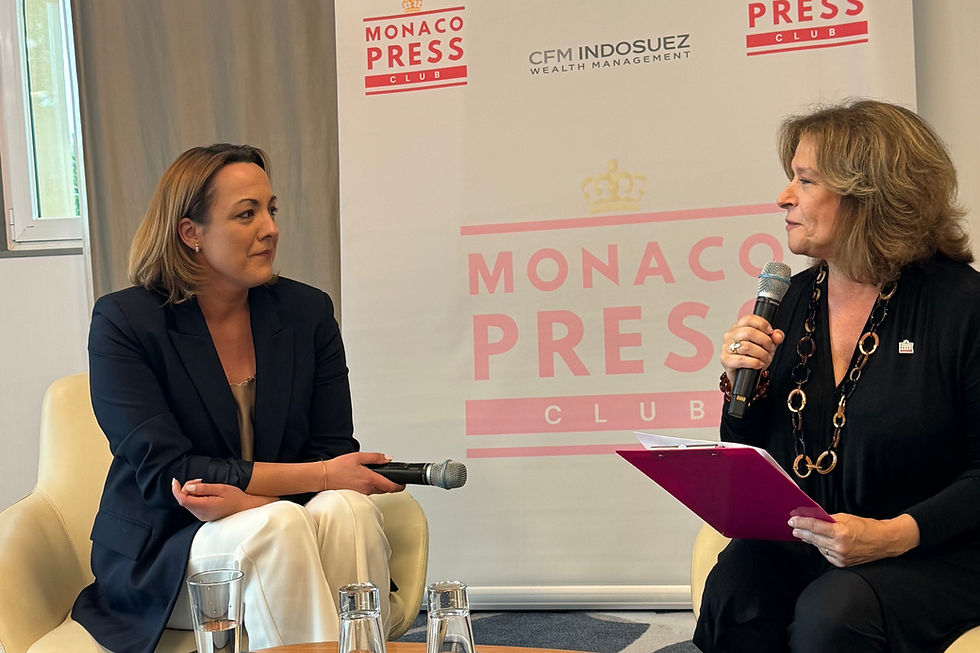
The exchange was candid, occasionally tense, but above all animated — a rare opportunity to peer behind the polished surface of the news that shapes our daily sense of reality.
“I came to this profession largely because of my father — he was a journalist,” she said, tracing the origins of a career that began rather early.
“At 12, I was already practising radio bulletins, and it was in Monaco that I did my first internship — asking my first questions with a microphone in hand.”
Fifteen years at TF1 and LCI followed, before her recent move to BFM TV.
“When you’re offered a position like this at 41, it’s difficult to say no. There’s responsibility, pressure… but also a challenge you feel compelled to take on.”
A recurring theme throughout the discussion was the gap between what appears on screen and what lies beneath it. “What you see on air is only a fraction of it. Much more happens off camera,” she noted. Years spent following the French president have left their mark:
“There are things viewers don’t see — the tension, the context, sometimes even the risks. That’s why it’s essential to listen to reporters on the ground. They sense what’s really happening.”
Her description of relations with politicians was characteristically unsentimental. “They need us, just as we need them. It’s a kind of moral contract.” Though not one without friction: “You’re sometimes made to understand you’ve said ‘too much’ or ‘not quite the right thing’. There are attempts to influence. But our role is to ask the questions — especially the uncomfortable ones.”
Modern journalism, she suggested, is defined by a permanent tug-of-war between speed and accuracy.
“Information cannot rely on a single source. Two is a minimum, three is better.”
And, with a hint of understatement:
“Being first matters. But being first with the right information matters more.”
Inevitably, the conversation turned to misinformation and the peculiar ecology of social media.
“We now have entire teams dedicated to verifying images. Because, at times, even we can get it wrong.” Yet she resists easy condemnation: “Social media is both the worst… and the best. Without it, we wouldn’t see much of what happens in conflict zones.”
Artificial intelligence, too, has made its quiet entrance into the newsroom.
“We are testing systems capable of fact-checking political debates in real time,” she explained. Still, she was careful to temper expectations:
“AI is a tool. It won’t replace journalists, but it can be a powerful complement.”
Perhaps the most telling observation of the evening concerned the public mood.
“There is a kind of fatigue. People are no longer interested in what we call ‘small politics’ — the soundbites, the quarrels. They care about real issues.”
Ratings, she noted, reflect this shift: political interviews are losing ground to coverage of international crises and security concerns.
Asked whether true journalistic independence still exists, she answered without hesitation:
“Yes, it does. But it has to be defended every single day.”
As for the future, she was pragmatic:
“Young audiences consume news on their phones. So formats are changing — podcasts, TikTok, short-form video.”
It was, in the end, less a masterclass than a reminder: that journalism, for all its rhetoric, remains a craft shaped by pressure, judgement, and a certain tolerance for ambiguity.
Comments